
Image sources:
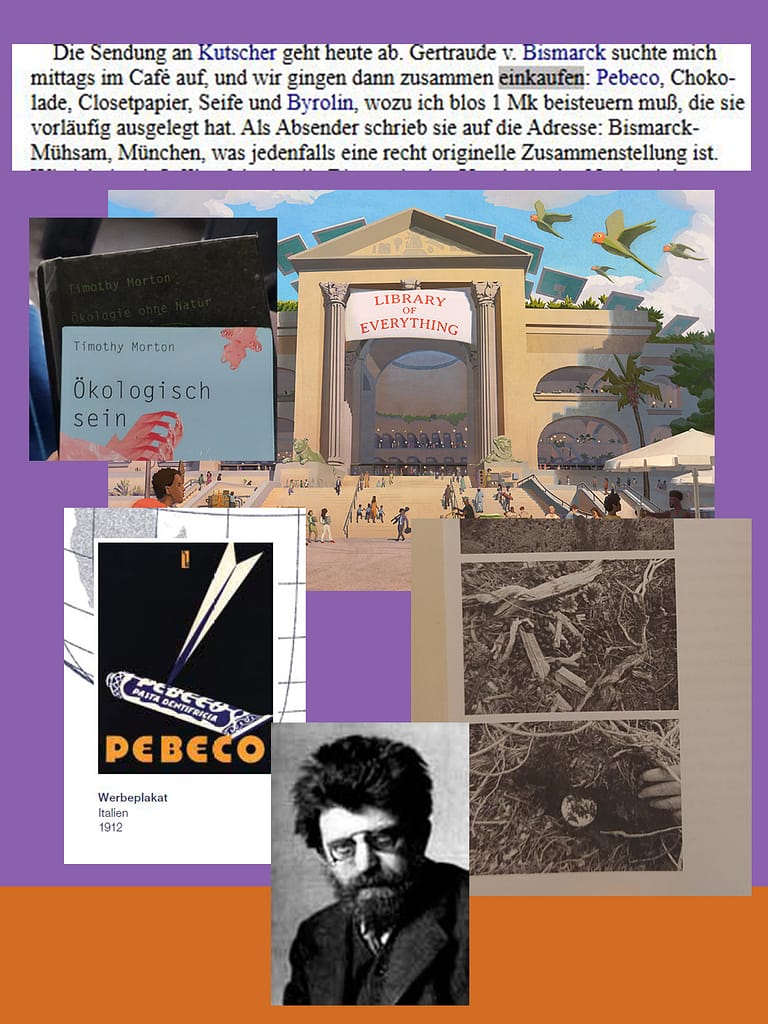
- Collage of Research Material: Excerpt from Erich Mühsam’s Diaries – 16.01.1915 https://www.xn--mhsam-tagebuch-gsb.de/tb/diaries.php#d_1915_01_16 ; Portrait of Erich Mühsam „Porträtfoto 1913“ https://www.xn--mhsam-tagebuch-gsb.de/images/general/em_1913.jpg; „The Library of Everything“ by Sean Brodley, Licensed under Creative Commons https://storyseedlibrary.org/art/sean-bodley-library-of-everything/; Pebeco Advert, Italy, 1912 https://www.beiersdorf.com/~/media/Beiersdorf/about-us/our-history/chronicle/2023/chronicle-04/Beiersdorf-chronicle-04-german.pdf; Fotography of the book „The Mushroom at the End of the World“ by Anna Tsing, taken by Hannah Schoenicke; Fotography of the books „Being Ecological“ and „Ecology Without Nature“ by Timothy Morton, taken by Hannah Schoenicke | All Rights Reserved
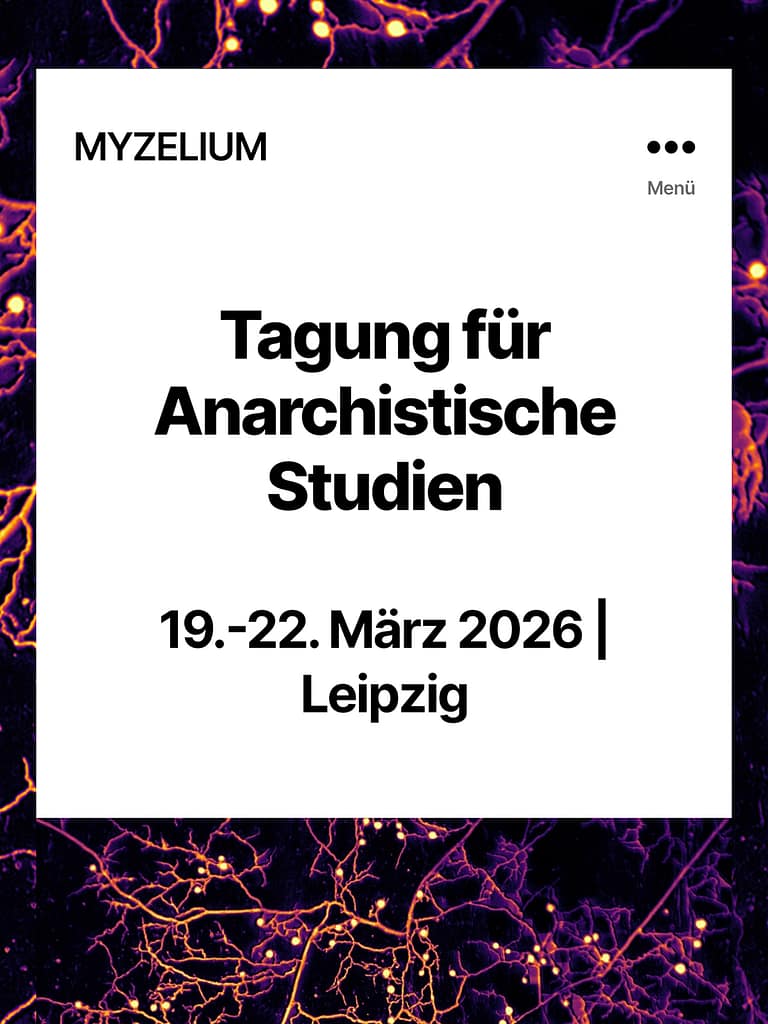
- Screenshot of website www.myzelium-tagung.de, taken on 09.03.2026: Myzelium Tagung
- Agaricus bisporus mycelium: photographed by Rob Hille (Own work) | CC BY-SA 3.0 Unported
‘Writing History – Fiction as an Anarchist Knowledge Practice‘ was a workshop I led at the Myzelium Conference on Anarchist Studies in Leipzig.
During the workshop, the participants and I explored the process of devising, writing and telling stories as an active anarchist knowledge practice: decentralised, collective and non-hierarchical. Across three time frames – past, present and future – we explored the various purposes that fictional narratives can fulfil as a method of knowledge production. For writing and telling stories means creating a fictional world that leaves a very real mark in our surroundings. Stories change and shape the world. They are personal by nature, connect us, and do not claim to represent an objective truth. They can serve as a tool of critical theory, making the invisible and the marginalised visible and tangible, and helping us to imagine and bring about (better) futures.